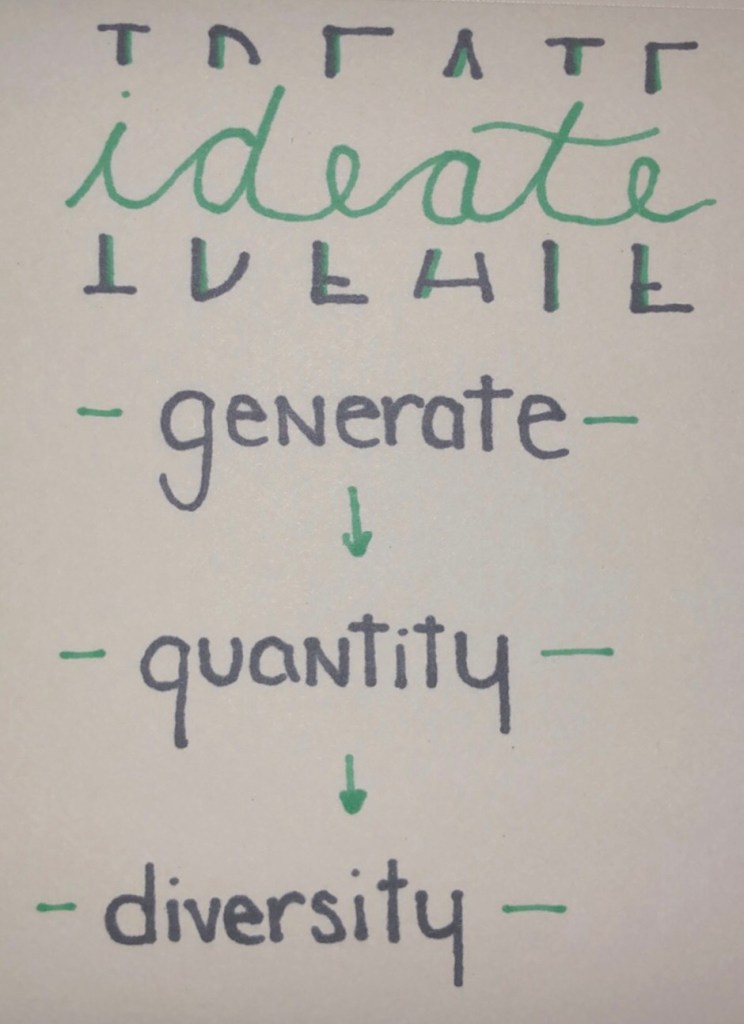
Continuing in the Design Thinking process, the ideation phase follows the define step. In the video, 3. Design Thinking: Ideate, Professor Hastings defines ideation as, “Coming up with as many ideas or solutions to a problem as you possibly can.” However, before you start spitting out ideas, you have to withhold all judgment. Professor Hastings also goes on to state, “The getting as many ideas out at the beginning is the critical part and for that, we have to suspend judgment, and suspending judgment not only of our own ideas but of other people’s ideas.” This is important so that no ideas get thrown out without being explored to their full potential.
In my Design Research and Methods class, we watched videos and went through workshops in an attempt to open up the creative pathways in our minds. These pathways get shut off in our daily lives and for the most part, we are unaware of that. We were challenged to come up with as many ‘wacky’ apps as we could possibly think of in just a few minutes. From that list, we had to create 10 concept designs for the apps that we thought of. We had to shut off the part of our brain that thought of apps as being something that has a purpose and open up our creativity to come up with things as unusual as we possibly could. To further this idea, we were challenged even further to do an improvised advertisement for a wacky app. This exercise truly opened up the idea that our apps could be even more unusual than we had imagined.
Of the videos that we watched in class, one was an episode of a Netflix series, Abstract: The Art of Design. The episode we watched follows Christoph Niemann, a designer for The New York Times, in his daily life as he works through his designs. In his design process, he explained the importance of having as many ideas as possible. “ I couldn’t have one idea that solves the entire thing. I had to start somewhere and then say, ‘Okay is this strong enough or flexible enough to just go to the next step?’” This is the main point of ideation, having as many ideas as you can think of, and then sorting them our for quality later on.
We also watched a Creativity Bootcamp that was hosted by Stefan Mumaw. At the beginning of the video, he explains the idea of what it means to be creative. He states, “There are qualifications to what creativity is. Creativity is problem-solving, but there are two key characteristics: relevance and novelty.” He then goes on to explain just what exactly these two words mean. He states, “Relevance is the degree by which a problem is actually solved… But then novelty is really that degree of uniqueness or originality that that solution processes and that’s our varying degree isn’t it?”
When we are coming up with ideas, some may fall into the category of either relevance or novelty. But it is important to find an idea that falls in between the two for the best results. Christoph Niemann explained this using the idea of an illustrated heart that means love. He states, “When you illustrate it, as just, like, a red square, which is the ultimate abstraction of a heart, nobody knows what you’re talking about, so the idea totally falls flat.” This is when an idea is on the novelty end of the spectrum that throws functionality out the window. Niemann also states, “When you go all the way to realistic and draw an actual heart made out of flesh and blood and pumping, it’s just so disgusting that the last thing anybody would ever think about is love.” This is on the relevance end of the spectrum that is focused on total functionality. Christoph Niemann goes on to say, “And somewhere between that abstract red square, and the real, kind of butchered heart, is the graphic shape that kind of looks like that, and kind of looks like that, and it’s just right to transport this idea of a symbol for love.” This is the perfect balance between novelty and relevance, where all great ideas land.
Out of all phases, ideation is the stage designers can experiment and have the most fun with to come up with a variety of solutions. Everything that comes to mind is on the table and is a valuable option for a solution. Get out there and open up your creativity in the ideation phase!
 CRyder Design
Leave a comment