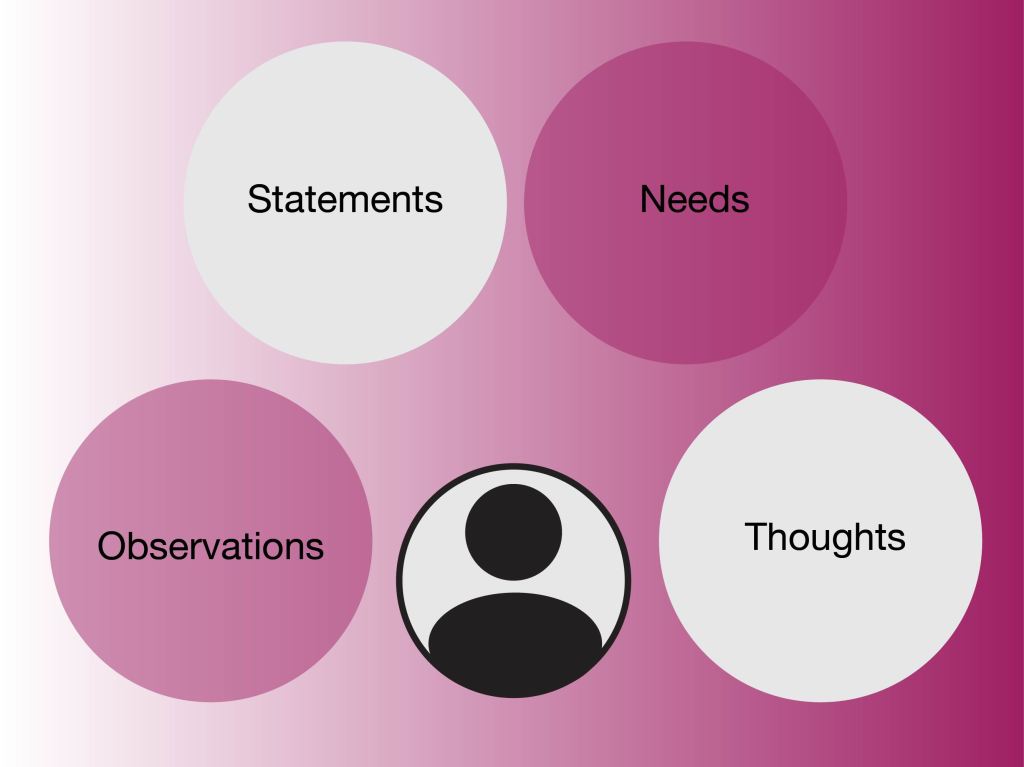
As you move forward in the design process, you have the ability to build on top of the foundation of research that you’ve built. The research that has been conducted in the previous step can be a lot of quantitative data to look at and quickly comprehend. Empathy maps and personas help to understand the needs of your audience by condensing the information into something that can be looked at, understood, and used in future decision-making.
In most cases, the next step following the initial research on your product will be to create an empathy map. Author, Sarah Gibbons defines an empathy map as “… a collaborative visualization used to articulate what we know about a particular type of user. It externalizes knowledge about users in order to 1) create a shared understanding of user needs, and 2) aid in decision making” (“Empathy Mapping: The First Step in Design Thinking”). Empathy maps aid in summarizing the thoughts, feelings, observations, and statements of the users. By having this overview of the user’s thought process, if there is a certain decision that needs to be made in the future the designer can consider this thought process to consider a possibility of what the user would think or feel about the decision. Authors Rikke Friis Dam and Teo Yu Siang state, “An empathy map will help you understand your user’s needs while you develop a deeper understanding of the persons you are designing for” (“Empathy Map – Why and How to Use It”). Additionally, empathy maps typically set up the blueprint for building personas to represent your audience.
Personas are meant to personify or put a face, a name, and a background to your research to represent a portion of your user audience. Authors, Rikke Friis Dam and Teo Yu Siang state, “Personas add the human touch to what would largely remain cold facts in your research. When you create persona profiles of typical or atypical (extreme) users, it will help you to understand patterns in your research, which synthesizes the type of people you seek to design for” (“Personas – A Simple Introduction”). Designers typically use the information from the empathy maps which they created to build their personas. Furthermore, just as empathy maps were used to condense data, personas do something similar. Author, Matt Ellis states, “Referring to a persona rather than raw data makes it easier for decision-makers to reason out the best course of action…Instead of going through each separate user test and analytics report, the persona has all of the relevant information in one clear location” (“How to Create a User Persona”). Designers can refer to personas and consider what that person would think of a certain aspect of their design. To step out and consider potential opinions that the target audience would have, is critical in the process of user-first design.
Progressing through the design process, it is likely that decisions will not get any easier on the designer or team. Referring to personas and empathy map might take away some of the confusion and grey area that develops. Empathy maps and personas are essentials to keep in your design toolbox through the next steps in the process.


Leave a Reply