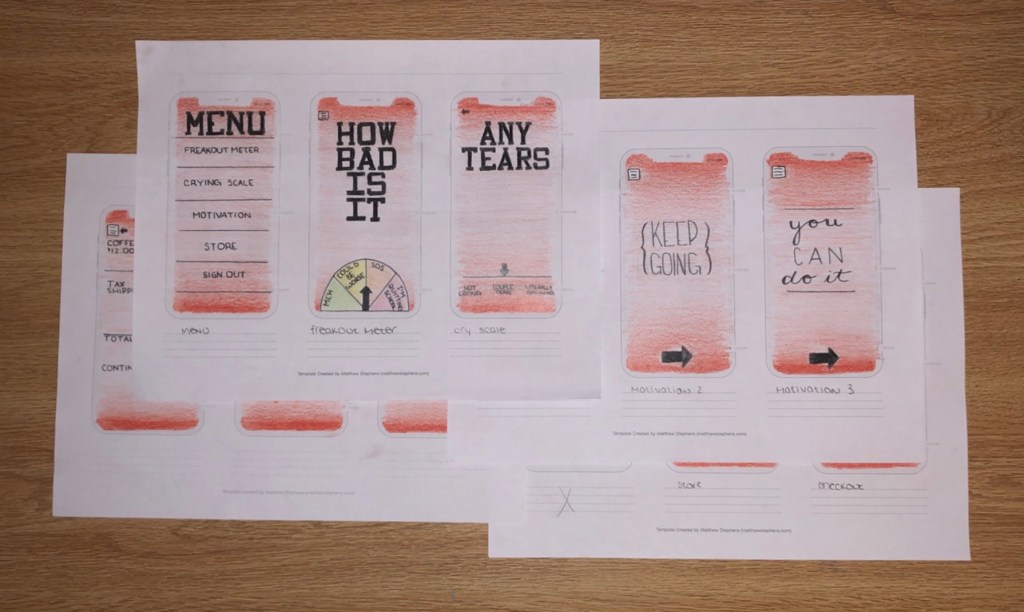
The prototype step in the Design Thinking process is the point where you begin to turn your ideas into things you are able to physically interact with. These prototypes are typically made very simple so that not much time is lost in the process. They are the first rendition of the things you imagined in your head, and while interacting with them you are able to quickly identify things that will and won’t be included in the final product. In the article “Stage 4 in the Design Thinking Process: Prototype,” authors Rikke Dam and Teo Siang state, “Prototypes are built so that designers can think about their solutions in a different way (tangible product rather than abstract ideas), as well as to fail quickly and cheaply, so that less time and money is invested in an idea that turns out to be a bad one.” The main concept of the prototype phase is to quickly and easily figure things out so that improvements can be made and the end result is as good as it can possibly be.
There are different types of prototypes that vary on the amount of time spent, expense, and feasibility. These types include: low-fidelity prototypes and high-fidelity prototypes. “Low-fidelity prototyping involves the use of basic models or examples of the product being tested…High-fidelity prototypes are prototypes that look and operate closer to the finished product” (“Stage 4 in the Design Thinking Process: Prototype”). Each type has a number of pros and cons that come with them as well as a different amount of time constraints. Depending on the stipulations of your project, one may be more feasible than the other.
Prototyping is typically something that can be completed in a short period of time. You are able to quickly weed out the ideas that don’t work and focus on the ones that do. In the video “Design Thinking 2 Rapid Prototypes HD” the narrator states, “Great prototyping is fast. Remember the funnel your team’s filling with empathy? Well by the time you’re ready to prototype you’ve already invested a lot of time and effort.” However, in order for this phase to go quickly successfully, it is important to come up with a number of different ideas and possibilities. In the video “4. Design Thinking: Prototype” Professor Hastings says, “It’s multiple attempts. There’s no such thing as one of something. We’re always producing many versions, many variations and we call that iteration.” When you have multiple ideas to build upon, prototyping can be executed more easily because you have room to throw out ideas while still having more left to work with.
From the prototype stage, you can bring the best products of your bunch to the next stage, test. In the test stage, users are able to give unbiased feedback and data on your prototype that will allow you to improve the design and build upon it. You will be able to create an even better prototype that can be tested again and possibly pushed on to be a finalized product. Go out there and get creating!
 CRyder Design
Leave a comment