
I recently went through the process of a ‘data detox’ and for this process, I decided to give up Instagram for 5 days. Making this decision was very difficult for me. I bounced around ideas of different social media that I use, what I use them for, and how often I use them to help me choose. I landed on the idea of Instagram because I feel as though I fall victim to the mindless scrolling that the designers and programmers have developed. I will spend hours a day scrolling through Instagram hoping to see something that is somehow life-changing to me — spoiler alert, I still have yet to discover a life-changing post. All-in-all this was a social media platform that I felt didn’t really provide me with any benefits in my daily life. Most times I leave with the same mindset I started with and only started scrolling out of boredom! The truth is, I don’t need to see what everyone I’ve met in high school and college are doing on their weekends, or pictures of their animals (though I do enjoy them), and the new color they dyed their hair. I wanted to learn and understand what effects Instagram was having on me, and study those through a detox of its usage.
I set out to study a variety of factors in this process. Every time I was tempted to go on the app, I would make note of the date and time. I wanted to learn if there was a pattern of the times my brain was craving some Instagram use. I would also make note of why I wanted to use the app, to learn what my reasoning would be. At the end of my study, I wanted to be able to answer several questions I created at the beginning.
- Do you feel like you missed out on anything?
- Did you experience any type of FOMO (Fear of Missing Out)?
- Did you feel more of a disconnect from your online presence or connection in your physical presence?
- Was there anything you wanted to share in your time away?
- How many times did you want to use the app?
- Were there any patterns in your desire to use the app?
- How did you feel during your time away? Did this change over time?
- What did you learn from the detox?
These are the answers to my questions.
- Yes, I felt as though I was not clued in on events that were going on. I get more of my information than I realized from Instagram. For example. The 2021 Met Gala was going on during the time of this study, and I was unable to see any sort of updates on what the celebrities were wearing or any sort of dramatic events that took place. I also felt as though I was excluded from my friends and their activities.
- I experienced more FOMO than I ever would have expected. I didn’t think that being unable to check my Instagram would vastly affect my day-to-day life but after keeping a record of how many times a day I wanted to check it, I realized that I have more of an addiction than I thought.
- I felt more of a disconnect from my online presence than anything. I did not feel any more connected to my physical presence because all I could focus on was how frustrated I was that I could not check my Instagram.
- I didn’t want to share much in my time away. I don’t post too much on my personal Instagram, but I do like to keep my professional design Instagram up to date on my everyday project process and updates.
- I wanted to use the app a total of 57 times over the 5 day detox period. 9 times on day 1, 13 times on days 2 and 3, 15 times on day 4, and 7 times on day 5.
- Most times I wanted to check Instagram were in spurts. About 2 to 5 minutes apart. I was expecting it to be more spread out, but when I wanted to check it they were in groups, then I would go a few hours without wanting to check, then I would want to check it a few times in a matter of minutes.
- I was frustrated in my time away. As time went on, my frustration grew because I felt like I was missing out on more information as time went on.
- I learned that I am more addicted to Instagram than I thought. Before this study, I did not think that giving up my Instagram would be a big deal and that it wouldn’t affect me much because I didn’t think I checked it too often. I was wrong.
As I began the study, I wasn’t sure what kind of emotions I would be feeling. I expected to feel a sense of relief that I could be more present in my day-to-day life, and wouldn’t have the mental obligation to see what my friends and family were up to on my Instagram. However, what I felt was quite the opposite. I found myself trying to go onto Instagram, and becoming frustrated when I could not. I felt as though I was missing out on all of the major events that were going on, and I was clueless about that information. In the article “Have Smartphones Destroyed a Generation?” author Jean Twenge addresses this occurrence. The article states, “What’s the connection between smartphones and the apparent psychological distress this generation is experiencing? For all their power to link kids day and night, social media also exacerbates the age-old teen concern about being left out.” I did experience the feeling of being left out when I was not able to see what my friends are up to. It was almost like I was excluded when I did not have the means to see what exciting things they were sharing.
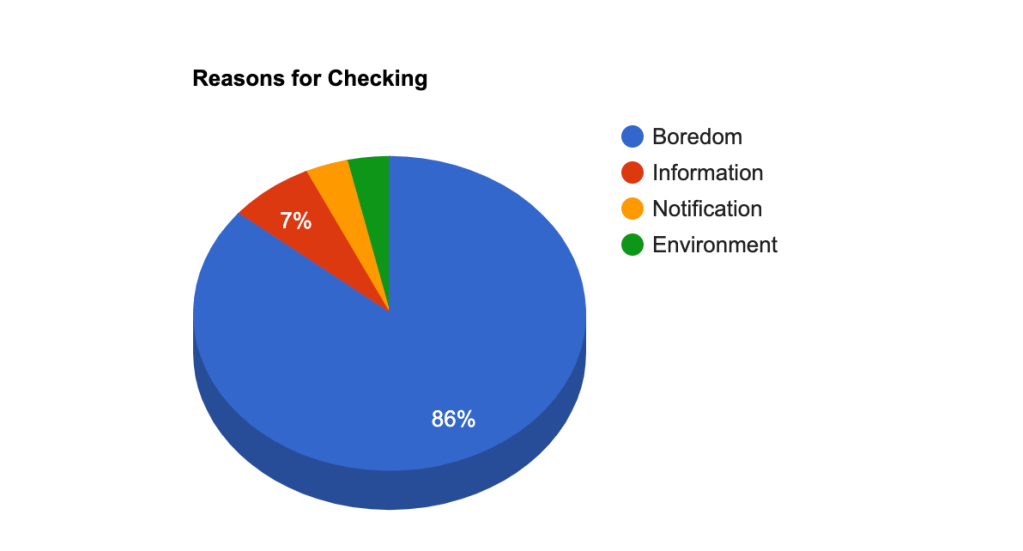
Of the times I wanted to check Instagram, I kept track of why I wanted to use it. Boredom accounted for 85.96%, checking for information accounted for 7.02%, because I got a notification accounted for 3.51%, and because I saw someone else using it accounted for 3.51%.

After this 5 day detox, I realized that I resort to Instagram for most of the information that keeps me up to date. I don’t use Twitter and have no real reason to turn to other sisters and sources when all of the information I am looking for is located on one app, Instagram. The article, “The Web We Need To Save” discusses this concept. Author, Hossein Derakhshan states, “The Stream now dominates the way people receive information on the web. Fewer users are directly checking dedicated web pages, instead getting fed by a never-ending flow of information that’s picked for them by a complex — and secretive — algorithms. The Stream means you don’t need to open so many websites anymore… You open Twitter or Facebook on your smartphone and dive deep in.” Personally, Instagram is my form of The Stream that Derakhshan is talking about. I know I can’t necessarily find all the information there, but I can find what I need and that satisfies my desire for current content.
Following this study, I realized how much of a role social media, specifically Instagram, plays in my life. However, as a part of what Jean Twenge refers to as “iGen” the generation “born between 1995 and 2012” (“Have Smartphones Destroyed a Generation?”) I’m not sure I’m entirely to blame for my addiction. I know no world without smartphones and social media. It was just a part of my life and experiences growing up for my generation and I. Jean Twenge states, “I realize that restricting technology might be an unrealistic demand to impose on a generation of kids so accustomed to being wired at all times… I have already witnessed firsthand just how ingrained new media are in their young lives.” Smartphones and social media are to my generation as Walkman’s and pagers were to the generations before us. It is only the media that defines us.
 CRyder Design
Leave a comment