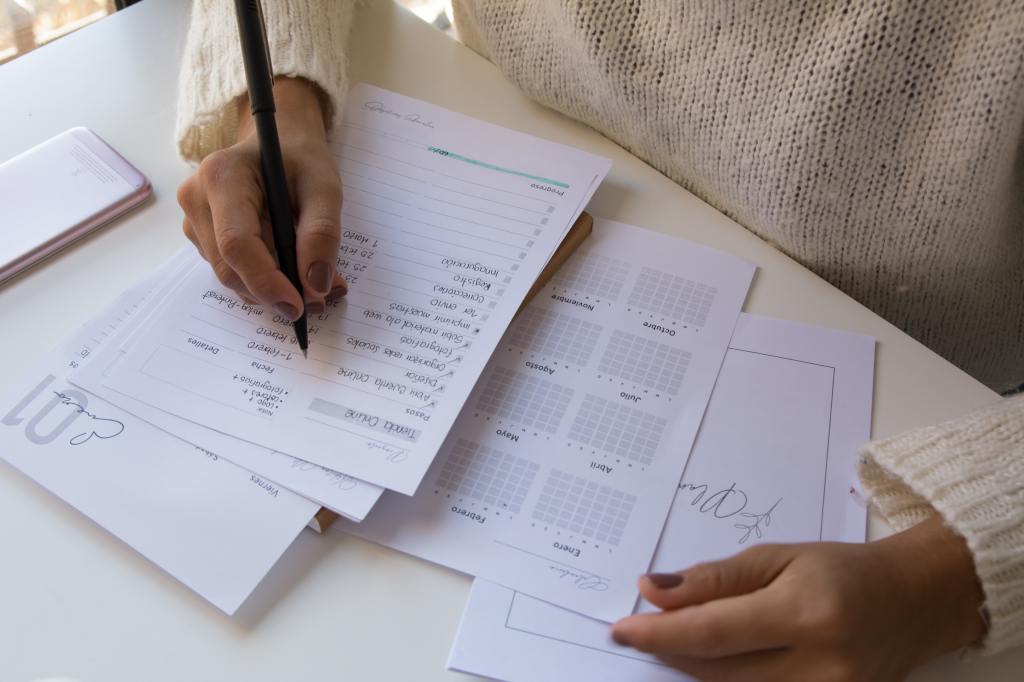
Organization is a key element in the design process. Keeping track of files, elements, and deadlines all in a collaborative setting can seem like a daunting task, but it doesn’t necessarily have to be. Staying organized while designing will make the process go smoother for everyone involved. It eliminates the panic of having to search high and low throughout your entire computer and hard drive to find the one file your coworker, or client is asking for. However, it is important to conduct research and talk with your team to find the best approach for your team’s project management system.
There are several different approaches to choose from when deciding which project management system works for you, your client, and your team. In the video “Project Management Approaches” Professor Hastings discusses the waterfall, agile, hybrid, design thinking, and kanban approaches.
Waterfall tends to be a fairly linear system of project management. The article “Waterfall Project Management Methodology” describes it as, “…a project management approach where a project is completed in distinct stages and moved step by step toward ultimate release to consumers. You make a big plan up front and then execute in a linear fashion, hoping there won’t be any changes in the plan.” While waterfall does create an overall outline for the process of creating an end result product, it does not always allow for fluidity among its development. Think of waterfall as a step-by-step process, one after another. You construct a list of steps at the beginning of a project and work through them to develop your product. When you complete the necessary actions for one step, you move directly on to the next.
Agile is beginning to take over where waterfall used to be practiced. Agile allows for a bit more fluidity among project management than waterfall does. “Agile methodology is a type of incremental approach to software development based on principles that focuses more on people, results, collaboration, and flexible responses to change. Instead of planning for the whole project, it breaks down the development process in small increments completed in iterations, or short time frames” (“Agile vs. Waterfall: Differences in Software Development Methodologies”). Because there is a lot more flexibility that comes with agile, it works better in areas that require a large amount of collaboration at each step. Nothing is set in stone and things are able to change throughout the design process. Team members are able to make adjustments as needed as the project develops.
Hybrid is a combination of both waterfall and agile methodologies. Teams are able to use what works for them from each method and combine them into something that works more efficiently than either did individually. The article “What is Hybrid Project Management?” states, “…the benefit of blended project management is that it allows you to get the best of various methodologies. This allows project managers to leverage the strength of their chosen approaches, while also navigating around their weaknesses or potential pitfalls. In the traditional sense of hybrid project management (meaning, combining agile with waterfall project management), projects are planned using the waterfall approach…However, projects are executed using an agile method. This leaves enough wiggle room to handle changes and reevaluate after short sprints.” Overall, hybrid is not as rigid as waterfall but not as fluid as agile. It is the best of both worlds and allows teams to collaborate among the project while also having a set guide for steps that need to be taken.
Design thinking is a project management methodology that considers users and the audience throughout the entire process. It consists of 5 different steps: empathize, define, ideate, prototype, and test. However, any of these stages can be revisited at any point within the design process. While they are a guide for how to go about the project, it is very common to go back and forth between different stages to ensure your team is developing the best product. “Design thinking is a human-centric approach in which problems are defined and resolved by empathizing with users, understanding how problems affect them, generating ideas, creating prototypes, and testing them on the intended end-users. Within project management, it can facilitate greater creativity and innovation. Benefits of design thinking include the ability to gain greater clarity over ill-defined problems, the opportunity to make changes after seeing a project in action, and the chance for project teams to ideate truly original solutions, even if they break from the established norms” (“Design Thinking Finds Its Place in Project Management”). Design thinking can be extremely beneficial because of the fact that it considers the product’s effects on users throughout the entire process. It is also fluid enough to allow for changes to be made and steps to be revisited at any point in the process to make necessary changes.
Kanban is an extremely effective method of project management that allows team members to visualize the flow of execution of steps while also being able to see what things have not been addressed yet, things that are currently being worked on, and things that are already completed. Kanban promotes organization so there is no confusion on who is doing what, and when. Virtual kanban organization also promotes collaboration among team members and allows them to share files, comments, and claim steps within the process. “Kanban is a project management tool that allows you to get a more visual overview of the tasks that either need to get done or are complete. At its core, it consists of a physical or digital board with three columns (to do, in progress, done) and tasks listed as story cards. Every card will be pulled from left to right until it gets done. Finally, they will leave the workflow. More advanced ones are web-based and include workflow limits and priority lanes for urgent tasks. Also, these task management tools are proved to be efficient for remote tasks too” (“What is Kanban?”). Kanban is a very transparent project management system, as everyone can see what is going on at any point in time. It enables team members to know who is working on what so they know who to talk to when questions, comments, or concerns arise. It is a very time-efficient method that proves to have a very high success rate.
As a full-time student, I have specific needs that need to be met with my organization. I typically have a very long to-do list, and it gets confusing fairly quickly. I like to organize things in order of due date to make sure I am completing the necessary work first so that everything is submitted on time. I experimented with each of these methods to find the best fit for me, and it was successful. Some of my assignments can not be completed in just one sitting and are a work in progress for a while until I get the time to sit down and complete them. Because of this, I prefer the kanban method of organizing things into do, doing, and done categories. With the kanban method I can see things that have not been addressed yet, things that have but are not complete, and things that are completed. Personally, this method of organization provides a lot of clarity and enables me to get things done.
While choosing which project management method works best for you and your team may seem like a laborious task, it is essential to conduct productive work efforts. You may find that as you move from project to project, your needs from your project management system may change as well. It is important to consider what you and your team need to get out of your project management method when choosing which one to utilize throughout your project.
 CRyder Design
Leave a comment