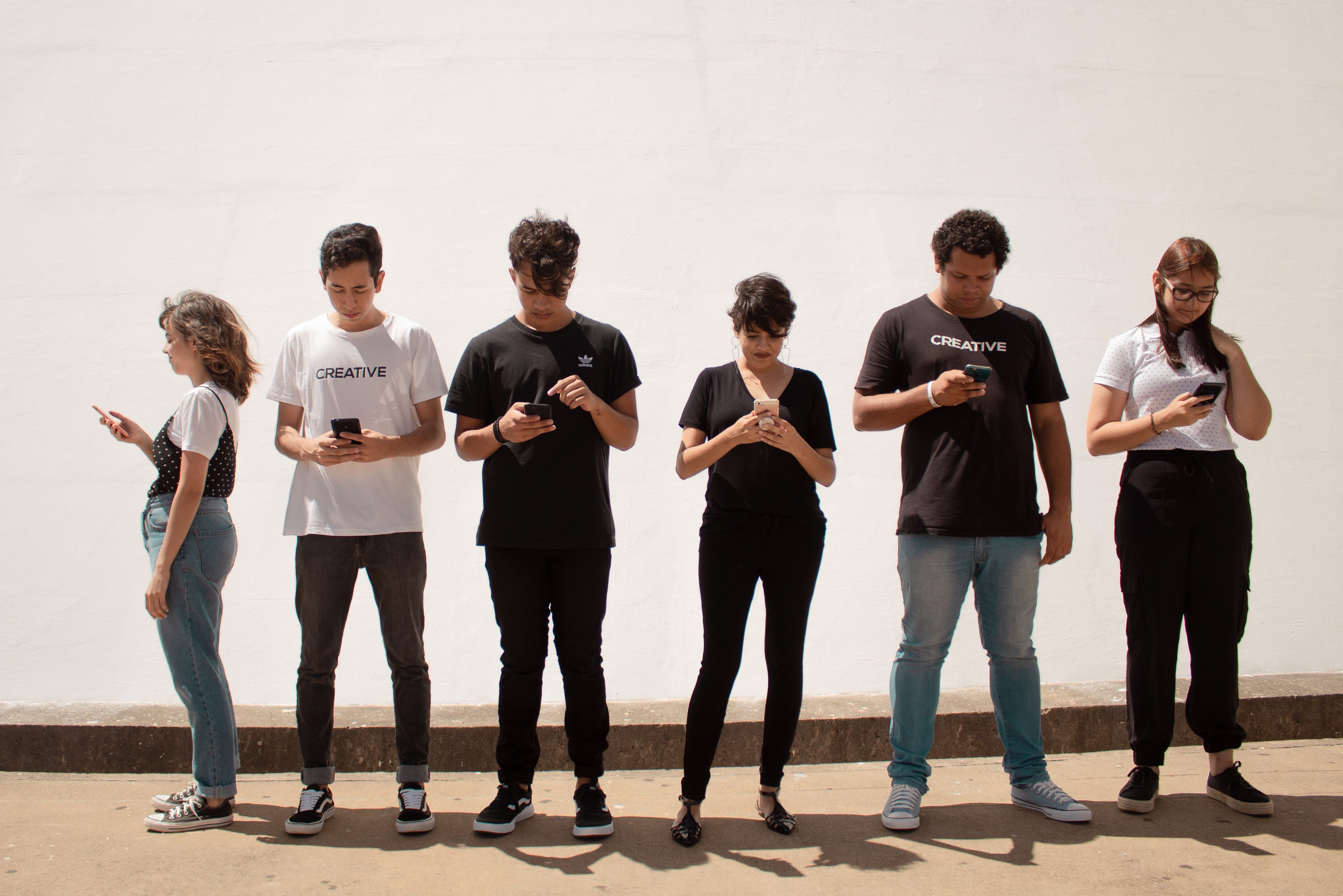
Smartphones are so prevalent in society today, it seems as though they are developing somewhat exponentially. Almost everyone has one on them at all times, everywhere they go. Smartphones are the lifeline of society, but at what expense? We may be giving up a lot more than we are aware of just for the sake of being constantly connected.
As smartphones continue to take over, it is hard not to notice the slow, steady disappearance of what were once everyday items as the need for them dies out. Author, Adam Greenfield refers to this idea as “dematerialization.” In the article “A Sociology of the Smartphone” Greenfield states, “But as the smartphone has come to stand between us and an ever greater swath of the things we do in everyday life, the global trend toward dematerialization is unmistakable.” Greenfield uses telephone booths as a prime example of dematerialization. What once used to be on every street corner is now almost impossible to find. Smartphones replaced them and they are no longer a necessity. However, it is not only phone booths that are disappearing, but also wallets. Wallets once carried cash, photo IDs, credit and debit cards, photos of loved ones, and so much more. However, all of this can be carried within a virtual wallet on a smartphone. On a virtual wallet, one can access credit and debit cards and even use them to pay for transactions just from their phone, it can also be used as a ticket to gain access to an event or public transportations. However, carrying a smartphone everywhere you go puts your privacy at stake. GPS can locate your smartphone anytime, anywhere, but your phone is sharing your location with third-party companies. “Most of us know by now that our phones are constantly tracking our location, and in fact have to do so in order to function on the network at all…Whenever we locate ourselves in this way, whether we’re quite aware of it or not, we are straightforwardly trading our privacy for convenience…When we move throughout the world with a smartphone in hand, then, we generate an enormous amount of data in the course of our ordinary activities…In turn, that data will always be captured and leveraged by any number of parties…” (“A Sociology of the Smartphone”). The data collected from your phone can be used to push targeted advertisements to you based on the places you were near or have visited. This happens daily. Have you ever been shopping, say to Target, and later that night you are scrolling through social media and see an advertisement for Target? Then the next day you head to PetSmart to pick up some food for your dogs, and later that night you see an advertisement for PetSmart? I know it has happened to me on multiple occasions, and probably more often than I was even aware of. While this may not seem like a big deal to some, it is particularly concerning that our privacy is not considered throughout this entire process. A user’s location can reveal a lot about them that they may not be comfortable with sharing, but they have no choice in the matter when they are carrying a smartphone in their pocket. Greenfield mentions, “…an Alcoholics Anonymous meeting, a fetish club, a betting shop, or a psychotherapist’s office…” (“A Sociology of the Smartphone”) all as places someone may visit and may not be comfortable having their location data shared. When we users are at locations like these, the data is no longer general, but personal. But are all companies collecting this data with the intent of profiting off of it? Not necessarily, but often the answer is yes. “Sharing your location data isn’t always bad. Many apps that use location do so with clear disclosures and provide useful services. Yet in some cases, companies collect the data seemingly for one purpose or another” (“Smartphones Are Spies. Here’s Whom They Report To”). While we continuously revel in the benefits and advancements of smartphones, it is important to stay aware of their pitfalls as well. Dematerialization is steadily turning our world virtual, and privacy is being taken advantage of as a result.
Because people are carrying smartphones with them everywhere they go, chances are that they are using them whenever they can. It is common to see an individual walking down the street, talking on the phone and sipping coffee, and another individual listening to a lecture and texting, or even working on homework and scrolling through social media. Our smartphones cause us to be multitaskers on a day-to-day basis. In the research paper, “The Illusion of Multitasking and Its Positive Effects” the authors found that multitasking improved engagement among participants. The authors state, “Across 23 incentive-compatible studies, totaling 6,768 participants, we find those who perceived an activity as multitasking were more engaged, and consequently outperformed those who perceived the same activity as singlet-tasking” (“The Illusion of Multitasking and Its Positive Effects”). Multitasking is beginning to become more prevalent in society, in education, and even in the office. Just as it is doing so, individuals believe that they are developing the necessary skill of being able to juggle multiple duties at once. As education is beginning to integrate technology-based learning and online classrooms into its curriculum, multitasking is also being integrated into the curriculum. Students often have to listen to a teacher or professor while also working on an assignment, and retain the information all at the same time. In the workplace, employees often have to handle multiple projects at once, while also reading and responding to emails, and collaborating with coworkers simultaneously. “Multitasking is also prevalent in the workplace, where most environments necessitate working under time pressure on several tasks simultaneously… In a survey we conducted with 434 participants (sampled based on age, income, and gender to reflect the US population), we found that 84% of participants reported that the ability to multitask is an important trait to have…” (“The Illusion of Multitasking and Its Positive Effects”). Though the majority of participants believe that being able to multitask is beneficial, the actual act of multitasking and its definition often vary from individual to individual. “…multitasking is often merely a matter of subjective perception. That is, holding the actual activity constant, some situations may cause people to perceive their overall activity as multitasking, whereas other situations may cause people to constitute the same activity as single-tasking” (“The Illusion of Multitasking and Its Positive Effects”). While one person completes a task they may perceive to be multitasking, another person may complete the same task and perceive it to be single-tasking. This perception may vary as a result of the context of the situation or even the way the task is initially framed and introduced. Although an individual may believe a task requires them to multitask, it does not necessarily mean they are. “Although the term refers to concurrent execution of multiple tasks, most tasks that require active attention cannot be done simultaneously… the prevalence of technology is bringing multitasking to almost every aspect of life, social scientists have so far focused on the detrimental effects of doing multiple tasks rather than just focusing on a single task” (“The Illusion of Multitasking and Its Positive Effects”). While perceived multitasking may improve engagement, it negatively affects productivity. It is very challenging to use your full efforts on one task when you are giving your attention to another.
The next time you go out to run an errand or sit down to complete a task, consider leaving your phone behind. It is not always providing you with something you can’t live without and could be affecting you more than you know of.
 CRyder Design
Leave a comment