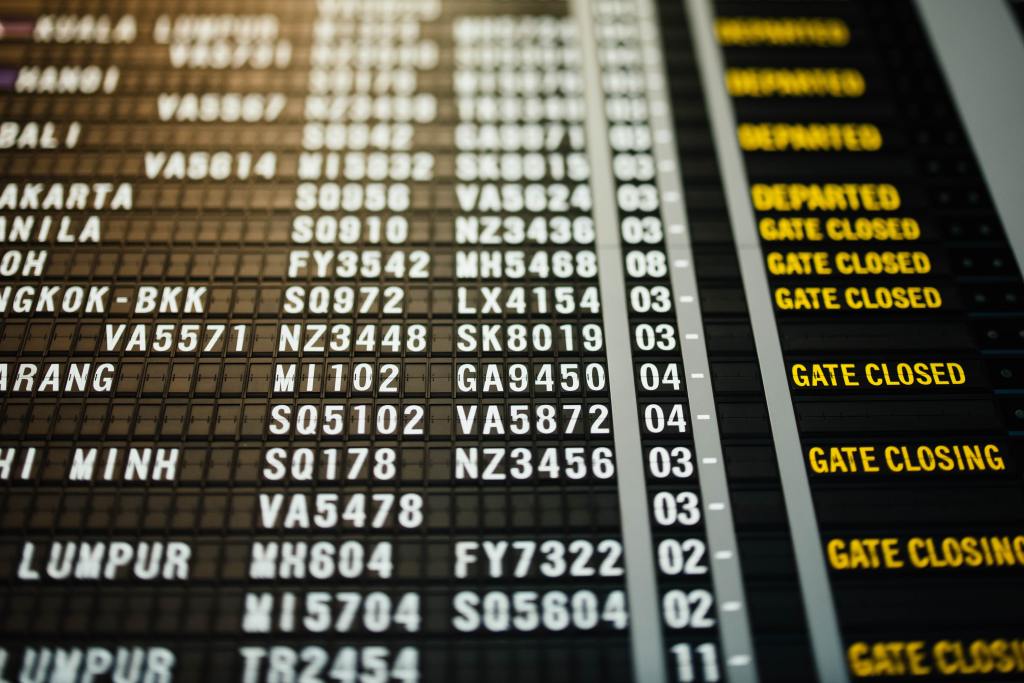
“It’s hard to fathom now, but we used to be able to arrive at the airport just minutes before a flight. We’d keep our shoes and coats on as we went through a simple metal detector, and virtually anyone could go right through the gate without a boarding pass or even showing ID… Now travelers often stand in long lines at security checkpoints with wait times that can exceed an hour. We take off our shoes, empty our pockets and take laptops and other devices out of carry-on bags before stepping into high-resolution, full-body scanners, while our bags go through 3D-imaging X-ray machines. And don’t forget to take your liquids of 3.4 ounces or less out of your carry-on.”
David Schaper
9/11 – 21 Years Later
The 21-year anniversary of the September 11th attacks on the U.S. is approaching in just a few months, yet the impact it had on America is still lasting. The events that took place on 9/11 undoubtedly changed history, but how has travel safety changed, and in what ways is it still changing? I’ve taken some data surrounding National Security, Customs and Border Protection, Military Spending, Department of Homeland Security, Air Passenger Miles, and TSA to assess this.
National Security
The National Security Agency (NSA) is a “U.S. intelligence agency within the Department of Defense that is responsible for cryptographic and communications intelligence in security” (Britannica). The NSA is responsible for security communications regarding the U.S. and “provides America’s leaders with critical information they need to defend our country, save lives, and advance U.S. goals and alliances globally” (NSA).
As you can see in the graph below, throughout the 1990s, National Security Spending was decreasing from 1992 to 1996 when there was a slight increase. However, in 2001 National Security Spending had a high increase to over $331 billion due to the September 11th attacks.
A large portion of the budget goes to the basic operating funds of the Department of Defense through the Pentagon’s base budget (National Priorities Project). The Department of Defense has the responsibility of arranging military forces to protect the security of the U.S.
Customs and Border Protection
Customs and Border Protection (CBP) works to protect entry points into the United States. “Officers inspect merchandise, agriculture, luggage, and people coming into and out of the United States, intercepting drugs, weapons, and other illegal goods before they get into the wrong hands and stopping people from trying to illegally enter the country” (U.S. Customs and Border Protection).
In the graph below you can see the number of processing and clearance of passenger planes, commercial planes, private planes, passengers (land and sea), automobiles, rail container, truck containers, vessels, and vessel containers by CBP from 2000 to 2007. You can see that the number of processing and clearances decreased after 2001, which can likely be attributed to higher security measures put into place after the 9/11 attacks.
Military Spending
Much like National Security, Military Spending also experienced a steady increase from 2000 through 2011 when it reached over $752 billion, and then began to steadily decline until 2016 when it began to increase once again. The money allotted for Military spending goes toward the payment, insurance, and training of military personnel as well as funding the development of military equipment, operations, facilities, and research.
If it seems like this is an extremely high amount of money, that’s because it is. The United States is an extremely wealthy nation and “spends more on national defense than China, India, Russia, United Kingdom, Saudi Arabia, Germany, France, Japan, and South Korea — combined” (Peter G. Peterson Foundation).
Department of Homeland Security Spending
The Department of Homeland Security “is responsible for counterterrorism, cybersecurity, aviation security, border security, port security, maritime security, administration and enforcement of our immigration laws, protection of our national leaders, protection of critical infrastructure, cybersecurity, detection of and protection against chemical, biological and nuclear threats to the homeland, and response to disasters” (Department of Homeland Security).
The Department of Homeland Security has had a unique pattern of spending from 2000 to 2022. As you can see in the graph below, the spending will increase for a few years (ex. 2000 – 2003) and then decrease a bit the next year (ex. 2004) before increasing again and repeating that pattern over and over again. Again, similar to both National Security and Military Spending the Department of Homeland Security had an increase in spending following 2001.
“…the U.S. government has spent more than $7.6 trillion on defense and homeland security since the 9/11 attacks…including the Pentagon’s annual base budget, the wars in Iraq and Afghanistan, and nuclear weapons-related activities of the Department of Energy.” (National Priorities Project).
Inflation
While the attacks on 9/11 are likely to have played a major role in the amount of spending to protect the U.S. it is no doubt that inflation also plays a role in the amount of spending as well. In the chart below you can see the U.S. inflation rate percentage from 2000 to 2022.
Inflation can be described as, “the rate at which the value of a currency is falling and, consequently, the general level of prices for goods and services is rising” (Investopedia). The higher the rate of inflation, the more money needs to be allotted to things like National Security, Military, and Department of Homeland Security Spending to ensure the highest level of safety.
Air Passenger Miles
In the months following 9/11 air travel had decreased drastically. In their book The Effects of 9/11 on the Airline Travel Industry, David Clark, James McGibany and Adam Myers explain that immediately after 9/11 the fleet of commercial aircraft was grounded for three days which “resulted in a 31.6% reduction in travel volume in September of 2001 compared to that same month in 2000 and generated massive industry losses.”
As you can see in the graph below, in 2002 the number of air passenger miles had largely decreased from the number of miles in 2001. This is likely due to the fears associated with air travel following 9/11. “The airline industry was particularly hard hit because commercial airlines were the weapon used by the terrorists in the attacks against the World Trade Center and the Pentagon” (The Effects of 9/11 on the Airline Travel Industry).
The number of air travel miles slowly began to increase in the following years until reaching an extreme low in 2021 due to the COVID-19 pandemic which halted most air travel. The numbers are beginning to increase again due to the reduction of COVID-19 restrictions.
TSA 2023 Projected Budget
Moving forward, there will still be threats but due to the increasing budget for TSA, National Security, Military, and the Department of Homeland Security, there is a high standard of security to protect the U.S. The budgets and amount of spending for each of these departments is likely to continue to increase as time goes on.
“TSA manages security policies for railroads, buses, pipelines, ports, mass transit systems, and highways. In transportation hubs, the TSA screens baggage and travelers at most of the major airports in the United States” (Criminal Justice Degree Hub). You can see the projected budget for TSA for 2023 in the graph below which represents the continued increase in spending to ensure the ability to address these threats appropriately and efficiently.
Where We Go From Here
“TSA officials say aviation security continues to evolve to address ever-changing threats, with a layered approach that involves surveillance, intelligence, and technology. The agency has 65,000 employees and spends billions of dollars each year in an effort to stay one step ahead of potential foreign and domestic terrorists… There hasn’t been a successful attack against commercial aviation in the U.S. in the 20 years since 9/11, and outside experts agree that while there is still room for improvement, the TSA has been effective in preventing another terrorist attack.”
David Schaper
 CRyder Design
Leave a comment